

Key Takeaways
- CNC wood routers use computer-controlled technology to automate precise cutting, carving, and shaping of wood, ensuring consistent and accurate results.
- These machines operate by interpreting digital designs and G-code instructions, allowing for complex patterns, repeatable production, and minimal manual intervention.
- Key components include a powerful spindle, secure worktable, advanced motion control system, and integrated computer software for design and execution.
- CNC wood routers are highly versatile, enabling the creation of furniture parts, signs, cabinetry, architectural elements, musical instruments, and custom art pieces.
- Benefits include improved productivity, reduced material waste, enhanced safety, and significant labor cost savings over traditional woodworking methods.
- Limitations involve setup complexity, environmental sensitivities, material considerations, and maintenance needs, which should be factored in when adopting this technology.
A CNC wood router utilises computer-controlled technology to automate precise cutting, carving, and shaping of wood materials through digital design interpretation. These advanced machines translate CAD files into exact tool movements, enabling consistent production of furniture components, cabinetry, signage, and architectural elements. Professional manufacturers leverage this technology for enhanced productivity, reduced material waste, and superior accuracy compared to traditional manual woodworking methods.
What Is a CNC Wood Router?
A CNC wood router is a computer-controlled machine that automates cutting, shaping, and carving tasks on wood. The CNC system interprets digital designs through software, translating them into precise tool movements. Stepper or servo motors guide the router bit along coordinated axes, allowing execution of complex patterns and intricate cuts without manual intervention. This machine uses a spindle with various cutting bits for operations like engraving, pocketing, or profile cutting.
Woodworkers use CNC wood routers for furniture components, decorative panels, cabinetry, musical instruments, and sign-making. Designs created in CAD (computer-aided design) software are converted into G-code, which directs the router’s actions. Fast speeds and repeatable accuracy distinguish these routers from traditional manual tools.
Industrial shops and small businesses integrate CNC wood routers to achieve high productivity, consistent results, and advanced creative expressions. Key features include an enclosed operating area, vacuum bed for material holding, automated tool changing, and dust collection systems. CNC wood routers streamline workflows and increase output for woodworking projects with detailed requirements.
Key Components of a CNC Wood Router
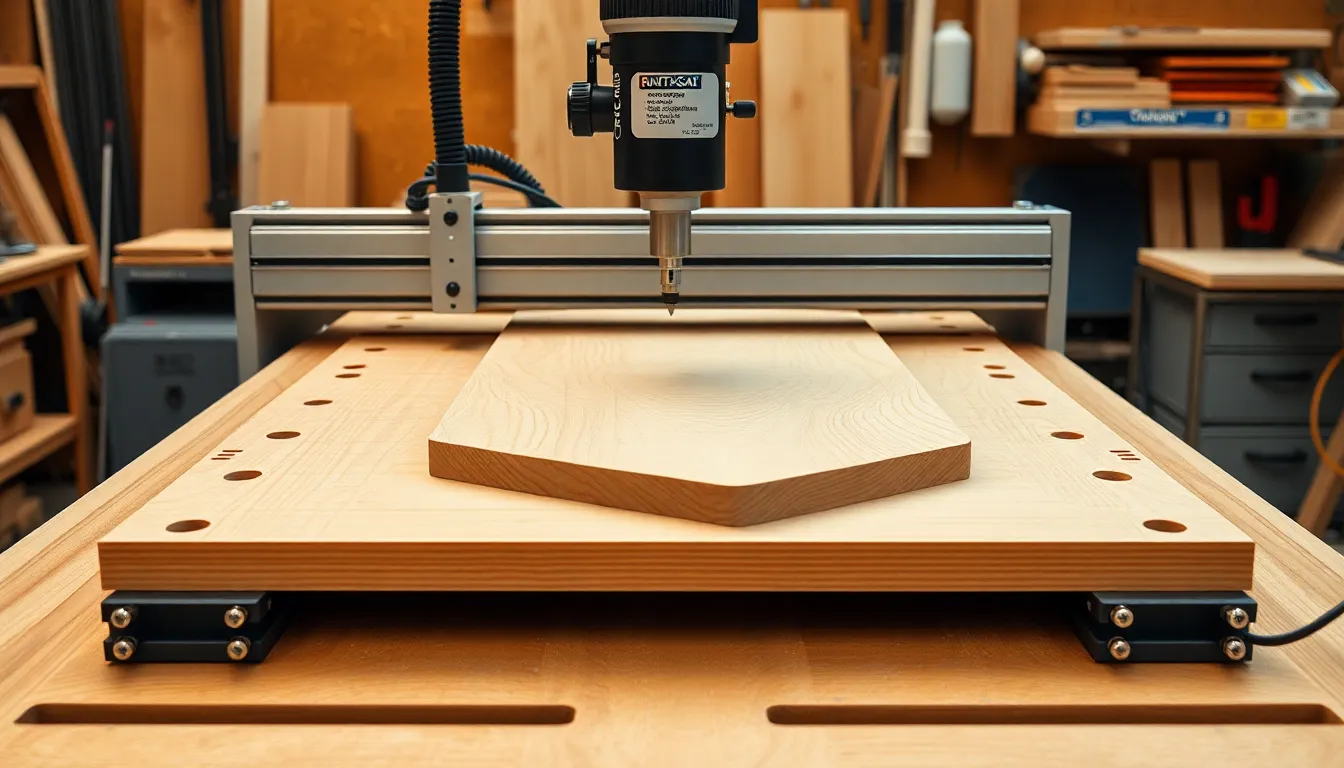
CNC wood routers rely on several integrated components to automate and control the woodworking process. Each component supports precise execution of digital designs and ensures consistent results for complex woodworking projects.
Router Spindle
The router spindle provides the cutting power in a CNC wood router system. High-speed electric motors drive the spindle at speeds from 6,000 to 24,000 RPM depending on application requirements. Hardened steel or carbide-tipped bits install in the spindle for cutting, engraving, or carving hardwoods, softwoods, and composite panels. Accurate spindle speed control reduces tool wear and material burn, supporting clean cuts for detailed patterns and profiles in cabinetry, sign-making, and decorative pieces.
Worktable
The worktable secures wood material during CNC routing. Vacuum beds, T-slot clamps, or mechanical hold-downs keep panels stationary, preventing shifting during high-speed cutting. Worktable sizes range from compact 24″x24″ models to large 60″x120“ industrial platforms, fitting single sheets or multiple workpieces. Surface flatness and rigidity ensure dimensionally accurate results across repeated cycles, whether routing furniture components, musical instrument blanks, or architectural elements.
Motion Control System
The motion control system moves the spindle and worktable along programmed paths. Stepper or servo motors drive linear axes, providing X, Y, and Z directional motion according to G-code instructions. Precision ball screws and guide rails convert rotary motion to linear travel with minimal backlash, allowing routers to maintain exact cutting paths. Integrated feedback sensors monitor position and speed to ensure consistent execution for complex artistic cuts, joinery, or 3D relief carving.
Computer and Software
The computer and software interface runs the CNC wood router and interprets user designs. CAD (Computer-Aided Design) tools create geometric layouts and decorative features. CAM (Computer-Aided Manufacturing) software translates designs to machine-readable G-code, specifying cut depth, toolpaths, and feed rates. Users input these files into onboard or connected PCs, which control every machine move for high-resolution carving, intricate shapes, and efficient batch production. Software updates and remote support keep router operations compatible with the latest workflow requirements.
How Does a CNC Wood Router Work?
CNC wood routers translate digital designs into physical woodwork through programmed, automated motion. Precision, repeatability, and speed define the machine’s performance at each stage.
Step-by-Step Workflow
Operators begin by creating a design using CAD software, specifying every cut, hole, and carving. They export the file to CAM software to set tool paths, machining sequence, spindle speed, and depth per pass. The system transforms this into G-code, which loads into the CNC controller. The router secures the wood on its bed—often with a vacuum system. Motors guide the spindle along predefined X, Y, and Z axes, machining the material accurately. Sensors monitor real-time parameters like position and speed, and built-in dust collection systems maintain work area cleanliness. Automated tool changers swap bits without operator intervention when designs require multiple cuts. Once the process completes, operators remove the finished parts, ready for assembly or finishing.
Role of G-Code and Software
G-code acts as the machine-readable language that powers CNC wood router operations. CAD software lets users create or import detailed woodwork designs. CAM tools analyze these designs, generate optimal pathways for the spindle, and convert instructions into G-code. The CNC controller reads G-code commands—directing spindle speed, trajectory, depth, and tool changes according to the plan. Reliable G-code execution enables error-free repetition and supports workflow automation in production settings. Software interfaces provide real-time visualization of the process, troubleshooting, and editing, which helps operators adjust parameters if needed for unique woodworking tasks. Robust integration of software and G-code underpins the consistent accuracy of CNC wood routers.
Types of Projects You Can Create
CNC wood routers enable the production of furniture parts, including chair backs, table tops, and cabinet doors, all with intricate patterns and precise cutouts. Sign-making applications include inlay lettering, 3D logo reliefs, and raised graphics for commercial or decorative signage. Cabinetry fabrication covers drawer fronts, shelving panels, and detailed moldings consistent in mass production.
Architectural millwork projects cover wall panels, decorative trims, and stair components, using repetitive accuracy for larger installations. Instrument manufacturing applications, seen in acoustic guitar bodies or wooden drum shells, use the machine’s precision for complex contours and tone-critical parts. Custom art pieces, such as wall murals and sculptures, benefit from the router’s ability to reproduce elaborate designs from digital files.
Prototyping for new product designs utilizes the router’s flexibility to create concept models, test assemblies, and evaluate ergonomics before final production. Home improvement elements like doors, window frames, or crown molding profiles also rely on the router’s consistency and detail. These project types illustrate the broad range of manufacturing tasks CNC wood routers handle with speed and accuracy.
Benefits of Using a CNC Wood Router
Improved precision and accuracy define CNC wood router operation. Machines interpret digital files and replicate exact measurements for repeatable cuts, reducing mistakes on intricate shapes like inlay pieces or engraved patterns.
Consistent quality stands out in high-volume production. Automated processes ensure that every cut, carve, and drilled hole matches the original specifications even across long production runs. For example, cabinet doors and detailed furniture panels remain uniform from piece to piece.
Enhanced speed and productivity result from automated workflows. Routers finish projects like sign faces or prototype parts within minutes compared to hours of manual effort. Shops scale up output without adding labor, maximizing project throughput.
Versatility expands project capability. Devices cut, engrave, and shape materials into components for furniture, musical instruments, and architectural décor. Operators produce simple cuts or execute 3D relief carvings with equal efficiency.
Reduced labor costs emerge from automated toolpaths. CNC systems require less hands-on material handling or manual measuring, which minimizes operator fatigue and the possibility of error during repetitive tasks.
Material efficiency increases through optimized nesting functions. Software arranges shapes for minimal waste, lowering cost per part on premium hardwoods or composite panels.
Improved workplace safety features on enclosed machines and built-in dust collection systems mitigate hazards common with manual routing. Operators interact with digital controls instead of directly handling spinning tools, reducing risk of injury.
Limitations and Considerations
CNC wood routers operate with high precision but require clean, dry environments since dust and humidity can affect electronic systems and material handling. Large-scale wood panels exceeding standard table dimensions, such as sheets over 4×8 feet, often need special fixtures or multiple steps.
Material selection impacts outcomes because wood types like plywood and MDF cut cleanly, while dense hardwoods may reduce feed rates and increase tool wear. Operators use sharp carbide bits and regulate spindle speed for best results with different woods.
Setup and programming can be time-consuming if project files contain complex toolpaths or high-detail graphics, as large G-code files slow upload and processing. Software compatibility issues or controller limitations restrict some advanced functions, such as 5-axis milling or gradient 3D carving.
Operators monitor machines for safe operation, since tool crashes from incorrect zeroing, part movement, or bit deflection cause damage. CNC routers produce loud noise and require dust collection to meet safety standards.
Energy consumption rises with high-speed and multi-shift operation, so shops factor in power costs when planning for automation at scale. Maintenance schedules for spindles, linear rails, and motion systems prevent unplanned downtime but increase total lifecycle costs.
About Yijin Hardware
Yijin Hardware, located in Homestead, FL, is a leading provider of precision manufacturing services.
Led by CEO Gavin Yi, Yijin Hardware offers a range of services including CNC machining, sheet metal fabrication, and custom fasteners. The company also provides additional solutions such as die casting, injection molding, and 3D printing, supporting industries like automotive, aerospace, medical, and energy. With a commitment to high-quality and reliable manufacturing, Yijin Hardware delivers tailored solutions to meet the unique needs of each client.
Contact:
Gavin Yi, CEO
Phone: +1 626 263 5841
Email: [email protected]
Address: 760 NW 10th Ave, Homestead, FL 33030
Website: www.yijinsolution.com
Frequently Asked Questions
What is a CNC wood router?
A CNC wood router is a computer-controlled machine used to automate cutting, shaping, and carving wood. It follows digital designs to produce precise and repeatable results, making complex woodworking tasks easier and faster.
How does a CNC wood router improve woodworking projects?
CNC wood routers enhance woodworking projects by providing high precision, speed, and consistency. They automate detailed cuts and shapes, reducing manual labor and allowing for more intricate and creative designs.
What types of projects can I make with a CNC wood router?
You can create furniture parts, cabinet doors, decorative panels, signs, architectural millwork, instrument components, custom art, prototypes, and home improvement elements like doors and window frames using a CNC wood router.
How does a CNC wood router work?
A CNC wood router translates digital designs into tool paths using special software. The machine moves its cutting tool along programmed axes, following G-code instructions for accurate and repeatable carving, cutting, or shaping.
What are the main components of a CNC wood router?
Key components include the router spindle for cutting, a worktable to hold material, stepper or servo motors for movement, motion control systems, computer and software interface, and often automated tool changers and dust collection.
What are the key benefits of using a CNC wood router?
Benefits include improved accuracy, faster production, repeatable quality, reduced labor costs, material efficiency, enhanced safety, and the ability to handle a wide range of woodworking projects with ease.
Are there any limitations to using CNC wood routers?
Limitations include the need for a clean, dry environment, consideration of material types, time required for setup and programming, potential for higher energy use, safety monitoring, and ongoing maintenance requirements.
Is a CNC wood router suitable for small businesses or hobbyists?
Yes, CNC wood routers are used by both small businesses and hobbyists. They help achieve professional-quality results, increase productivity, and expand creative possibilities without needing extensive manual skills.
How important is software for CNC wood router operation?
Software is crucial for CNC routers, as it translates your digital designs into machine-readable instructions. Good CAD and CAM software ensures accurate tool paths, error-free operation, and efficient workflow management.
Do CNC wood routers require a lot of maintenance?
Regular maintenance is necessary to ensure reliability and accuracy. Tasks include cleaning, lubricating moving parts, checking electronic components, and replacing worn tools to minimize downtime and maximize lifespan.